You have probably seen the ads. "Meet 100+ universities in one day." "Free entry." "Scholarships on the spot." Study abroad fairs pop up across the UAE, Saudi Arabia and India every few months. Some run by consultancies. Some by government bodies. Some by dedicated expo platforms.
But if you have never been to one, the whole thing sounds vague. What actually happens inside? Do universities really give offers at these events? Is it worth taking a day off school or work to attend?
This is a realistic starting point. No hype. Just what study abroad fairs are, how they work, who they are built for and what you should do before, during and after one.
What is a study abroad fair?
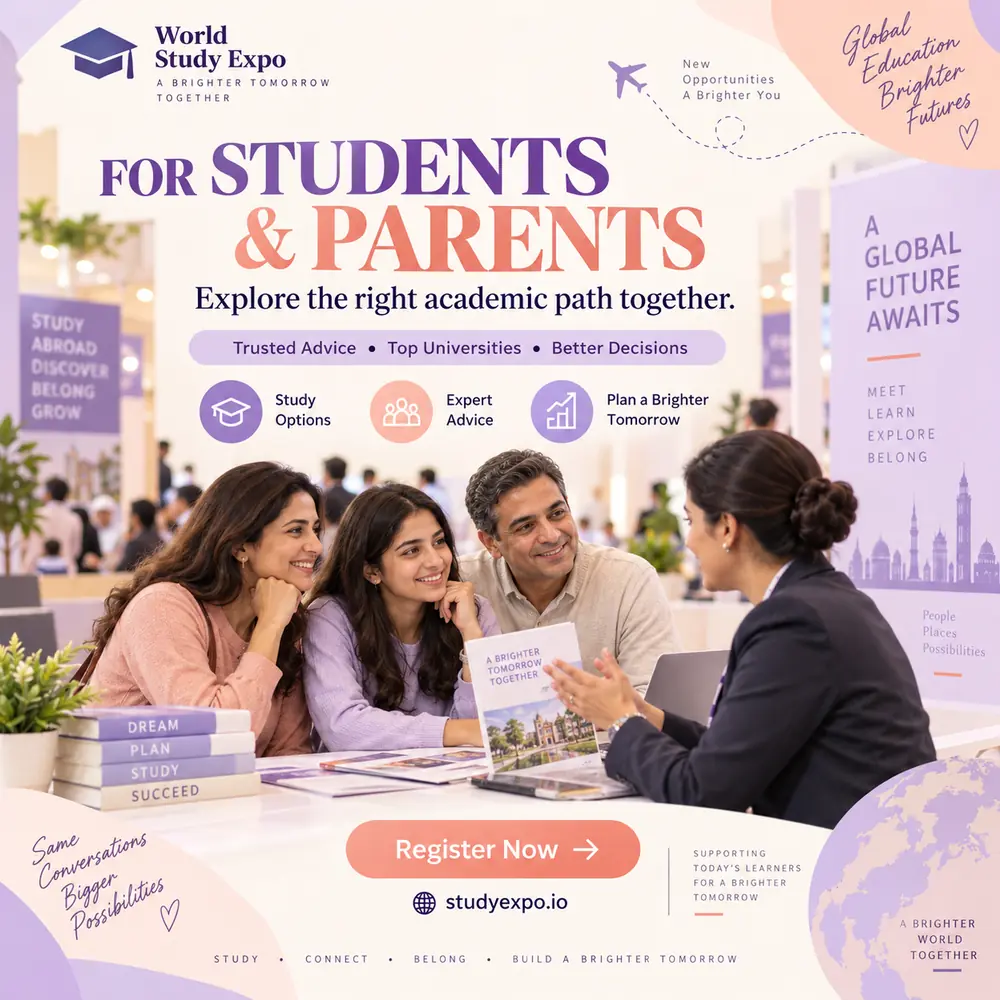
A study abroad fair is an event where universities set up booths and meet students face to face. Think of it as a marketplace for higher education. Each university gets a table or a stall. Students walk around, ask questions, collect brochures and sometimes sit for short interviews or eligibility assessments on the spot.
The bigger ones bring 50 to 200+ universities from multiple countries under one roof. You get UK, USA, Canada, Australia, Europe and sometimes newer destinations like Ireland, Germany and Malaysia all in one venue.
The format varies. Physical expos happen at hotel conference halls or exhibition centres in cities like Dubai, Abu Dhabi, Sharjah, Riyadh, Mumbai and Hyderabad. Online expos run on digital platforms where you can video call university reps from your laptop. Some events do both.
Entry is almost always free for students. The universities pay to exhibit. That is the business model. You are not the customer. You are the audience the universities are paying to meet.
Who are these fairs actually built for?
Three groups. And each one gets something different out of it.
Students in Grade 10 to 12 (or final year of school)
This is the primary audience. If you are 15 to 18 and thinking about studying abroad, a fair gives you something no website can: a real conversation with an admissions officer. You can ask about entry requirements, campus life, tuition, housing, visa support. And you can read the person sitting in front of you. Are they helpful? Do they seem honest? That tells you a lot about the university itself.
Parents
For Gulf families especially, the decision to send a child abroad is a family decision. Parents want to know about safety, accommodation, cost, return on investment and whether the degree is recognized back home. A good expo has a dedicated parents guide or a parents lounge where these conversations happen separately from the student crowd.
Universities and institutions
On the other side of the table, universities use these fairs to recruit students from specific regions. A Canadian university that wants more students from the Middle East will exhibit at a Dubai or Riyadh fair. An Australian university targeting Indian students will show up in Mumbai or Hyderabad. The expo is their recruitment channel.
What happens when you walk in?
You register at the entrance. Usually just your name, email, phone and what you are interested in studying. Some events give you a badge or a lanyard.
Then you are in a large hall with rows of university booths. Each booth has banners, brochures and one or two representatives. Some have screens with videos. The busy ones have queues.
You walk up to any booth that interests you and start talking. There is no set order. No appointments required (though some fairs let you book one in advance for specific universities). You can spend 5 minutes at a booth or 30 minutes. Up to you.
The conversations are surprisingly direct. Admissions officers at fairs are not reading from scripts. They want to know your grades, your test scores (if you have them), your preferred programme and your budget. Based on that, they will tell you straight whether you are a fit for their university.
Some fairs also have seminar stages where speakers talk about visa processes, scholarship opportunities, how to write a personal statement or how to pick the right country. These are usually worth attending, especially if you are early in the process and still figuring things out.
Can you actually get offers or scholarships at a fair?
Sometimes. It depends on the event and the university.
Some universities bring their admissions team and can issue conditional offers on the spot. Conditional means "we will accept you if you meet X requirements" (usually your final grades or an English test score). That is not a guaranteed seat, but it is a serious head start.
Scholarship information is often shared at fairs too. Some universities announce exclusive fair discounts or application fee waivers for students who apply through the event. These are real incentives, not marketing gimmicks. Universities pay to be at the fair and they want results from it.
But do not walk into a fair expecting to walk out with a full scholarship. That is not how it works. What you can walk out with is clarity on which universities match your profile, which ones offer financial aid and what steps to take next.
How do you pick which fair to attend?
Not all study abroad fairs are the same. Some are small consultancy events with 10 universities from one country. Others are massive expos with 150+ universities from a dozen countries.
Here is what to look at before you commit your Saturday afternoon:
- How many universities are exhibiting? More is generally better, but only if the variety matches your interests. If you want to study medicine in the UK and the fair only has Canadian business schools, it is not for you.
- Which countries are represented? If you have a specific country in mind, check the exhibitor list. If you are still undecided, a multi country expo is more useful because you can compare options side by side.
- Is it a physical event, an online event or both? Physical is better for in depth conversations. Online is better if the event is in another city or if you want to browse quickly. Some platforms run both formats so you can pick what suits you.
- Who is organising it? A government backed fair or a large international education provider tends to attract higher calibre universities than a small local consultancy event. Check the organiser website and past exhibitor lists.
- Is entry free? It should be. If a fair charges students to enter, that is unusual and worth questioning.
What should you do before going?
The students who get the most out of fairs are the ones who prepare. Even 30 minutes of prep the night before makes a huge difference.
- Make a shortlist. Look at the exhibitor list and pick 5 to 8 universities you want to visit. Do not try to talk to every booth. You will burn out and remember nothing.
- Write down your questions. What is the tuition for your programme? What are the entry requirements? Is there scholarship support for international students? What is the application deadline? What English test scores do they need? Having these written down means you actually get answers instead of just collecting brochures.
- Bring your documents. Carry your latest grade transcript (even unofficial), any test scores you have (IELTS, TOEFL, SAT) and a one page CV or activity list if you have one. University reps can give you much better advice if they can see your actual profile.
- Charge your phone. You will want to take photos of brochures, scan QR codes and save contact details. A dead phone at a fair is a problem.
What should you do while you are there?
- Start with your top 3 universities. Hit them first while you are fresh and the queues are shorter (most fairs are less crowded in the first hour).
- Ask specific questions. "Tell me about your university" wastes time. "What are the entry requirements for your computer science programme and do you offer merit based scholarships for international students?" gets you a real answer in 2 minutes.
- Take notes. After each conversation, write down the rep name, what they told you and any next steps. By the fifth booth you will not remember what the second one said unless you wrote it down.
- Visit at least 2 universities you had not considered before. Fairs are great for accidental discovery. Some of the best fits come from booths you walked past and stopped at on impulse.
- Attend one seminar session. The visa process talks and scholarship panels are usually more detailed than what any single booth rep will tell you.
What should you do after the fair?
This is where most students drop the ball. They go home, dump the brochures on a shelf and forget about it.
Within 48 hours, email the 3 to 5 university reps you had the best conversations with. Thank them, mention something specific from your conversation ("you mentioned the early application deadline for the engineering programme") and ask about next steps. These people talk to hundreds of students at every fair. A follow up email makes you memorable.
Compare your notes. Sit down with your family if relevant and go through what you learned. Which universities matched your budget? Which ones had the best scholarship options? Which ones felt right when you talked to them?
Start your applications. If a university gave you a conditional offer or a fee waiver, do not sit on it. These often have deadlines tied to the fair. The whole point of going was to move forward, so move forward.
Are online study abroad fairs worth it?
Yes, with a caveat.
Online fairs are better than no fair at all. If the event is in Dubai and you are in Oman or Saudi Arabia, joining online saves you a flight. If you are still in the early research phase, an online fair lets you browse without committing a full day.
But they are not the same as being there in person. The in person dynamic gives you things a video call cannot: reading body language, getting a feel for how the university treats students, having spontaneous conversations with other attendees.
The hybrid model (physical + online) is probably the best of both. Attend in person if you can. Join online if you cannot. Both are better than just reading websites.
One more thing worth knowing
Study abroad fairs are free. The universities pay to be there. Your only cost is your time. And if you walk in prepared, that time pays back in months of research you would have done alone on your phone.
The World Study Expo runs physical expos across Abu Dhabi, Sharjah and Dubai plus an online expo covering the wider Middle East and Asia. Free entry. Universities from USA, Europe, UK, Canada, Australia and more. If you are a student or a parent in the region and this is on your radar, it is worth checking the schedule and registering early. Spots at the physical events fill up.
Students can register for free here.
This article is general guidance for prospective students and institutions, not immigration, financial or legal advice. Entry rules, fees, scholarships and work rights change; check official government and university sources before acting.
Meet Universities at World Study Expo
Free for students and parents. Meet admissions teams in person in the UAE or online across the Middle East, India and Asia. Registration takes two minutes.